
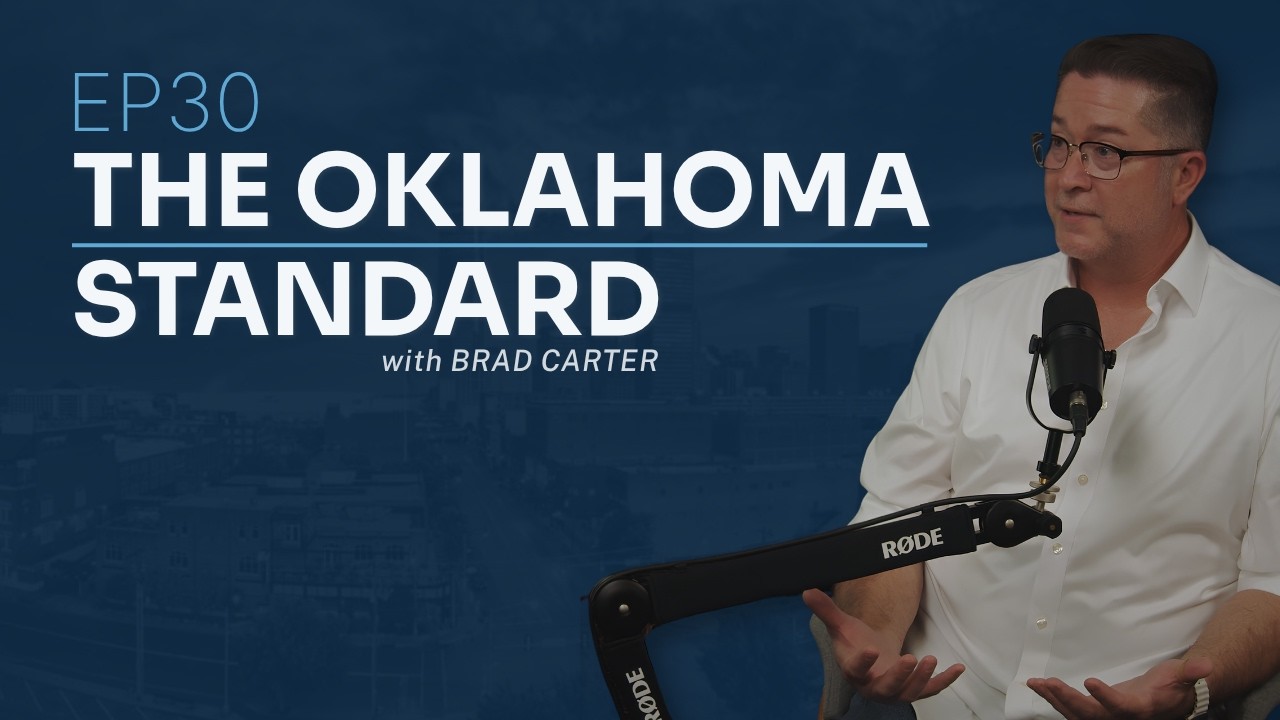



Brad Carter, Oklahoma City’s Ward 1 Councilman, joins Jed Chappell to ask what the city must protect as it grows. They discuss transparent public service, listening across political divides, jobs and AI, recovery, homelessness, and the Oklahoma Standard Carter hopes will still define OKC for the next generation.
Transcript
This transcript was generated from the published episode audio and lightly formatted for readability. It may contain errors in names or phrasing.
Read the full transcript
0:00 The City Councilman Brad Carter with Oklahoma City. Brad, thanks for being with us today, man. How are you? I'm doing well, Jed. Thank you for having me. So glad to have you. Gosh, Brad, how long have we known each other? 20 years? 20 years, man. Maybe something like that. Something like that, man. It's been a long time. Almost just a little bit after Bricktown Brad days, right? Quite a bit, yes. OK, those days are long gone. That's great. Before Jesus, right? Before Jesus. Before Jesus. So before we get into all the things that you're currently involved in,
0:52 why don't you tell us a little bit about you and your family, your wife, your kids, and what life is like for you today? So I have a beautiful wife of 20 years. We have five children, ages ranging from 15 to 21. OK. We're about to hit birthday season. That's awesome. So we've got a quick stretch and everybody's going to get a year older. Yeah. So we have a company called Grounds for Compassion. Yeah. And so we do coffee. We've had that for going on 16 years. It's kind of our way of affording to do ministry, I guess, in that sense.
1:28 Yeah. So it's our vehicle. I actually hated coffee when we started it, but God said do coffee, and so we wanted to be obedient. And it's been a blessing. I will say this. We had guests from Austin, Texas, in the heart of Austin, Texas, too. They came and, you know, we always provide Grounds for Compassion coffee for our podcast guests. And, you know, Austin is pretty known for its, you know, eclectic mix of foods and coffee and things like that. New suits, everything. Yeah. But they were going on and on about your coffee. And so I sent them a special gift package that you help provide. So I appreciate that. But yeah, it's quality coffee.
2:06 So if you are interested in finding a new blend, these are your people. So, yeah. So, yeah, tell us some more. Yeah, we love to do custom things and help people out. And a big portion of what we do for that is just coffee shops, churches, businesses, retail, online. Master's car wash. I go there and the guy there that works, there's a great guy. He talks about you a lot. Yeah. We do homeless ministry and outreach together. Church under the bridge. Yeah. Great, great ministry. But I would say recently, within the last six years, the Lord had asked us to consider moving into politics.
2:44 Yeah. And that was nowhere near on our radar. Sure. And, I mean, as you might know, I mean, having a colorful past. Sure. Kind of, you almost, you kind of preclude yourself. You think that you're not qualified. You're not doing anything. And so we, I actually looked at my wife and I told her, I said, you know, we'll be obedient. We'll run this race, but we're going to tell everybody. We're going to, we're not going to have any skeletons in the closet. We're going to make sure everybody knows everything. Yeah.
3:11 So we just, we use that as our testimony. Really hoping that it would not resonate with people and they wouldn't vote for me. Yeah. And I would just be able to turn around and go back to work. And quite the opposite. It resonated with a lot of people. I'm sure you know, over the years, we've, we've helped a lot of people and including, I mean, our family is, has been riddled with drug and alcohol abuse and different things going on. So we have a ministry that reaches out through that, mainly because.
3:40 Oh, we can hear about that more. I'd love to know more about that. Well, I mean, that's what we do within the coffee. With grounds. Oh, okay. That's awesome. Yeah. So everybody who works for us is walking recovery. Okay. So we sponsor some sober living homes. We hire from, from that area as, as much as we can. You know, we don't believe that everybody is going to be a lifelong employee or anything along those lines, but we want to help people get to that next step. Yeah. And a lot of times, especially at least in our lives, whenever we were walking through the recovery aspect of things, you just don't always feel that worth.
4:12 And you don't know what you're going to be able to step into and, and you know, whether you can hold on a job, whether you can do things. And so helping people get that courage up and get that experience, but also get the, the, oh, trying to think of the word now. I mean, just the self confidence. Yeah. To be able to make those steps. So we've been very fortunate to work with a number of people through that. And as we were knocking doors and as we were going through things, we had, we never found anybody who hadn't been touched in one way, shape or form because of addiction.
4:47 Yeah. And so the story ended up, you know, our testimony being the story resonated with so many people, um, that we actually got more votes than anyone had gotten in that district in that period of time. And so we, we felt very blessed with that, but it was also, now we were stepping into a new thing that scared the fire out of us. I didn't really know anything about politics. Um, I just knew that I wanted to be a help. I wanted to do things. And at the time, all I thought city council members did was fill potholes and, you know, fix roads and do different things and yell at each other.
5:21 Oh, or get yelled at, you know? So, man, we've been learning on the fly and there's just so many things that I was not aware of that we have to do just daily. Yeah. But we had learned during COVID that your local, you know, whether it's city council, whether it's mayor, your local, um, municipalities are the ones that impact your day to day life so much more than state or federal. A hundred percent. People don't realize that. Mm. And so we, we, uh, we take it very serious. It's something that we always want to make sure that we're reaching out to and helping people with. Um, I do my best to answer every email or every phone call.
5:59 Sure. Um, some, as much as I came with a smile, I would say, you know, but there, there are some people that don't like that part of it, but yeah. Yeah. Well, that's something I've always appreciated about you. You know, you, you're willing to go, um, to whatever links to communicate, you know, in, in, from a leadership perspective. And that's been really impressive to watch, you know, and, and impressive to, you know, watch you, you know, stand up for your faith in, in the, in that sector there. And, you know, and, you know, I, I, I would venture to say, if you know,
6:29 if you and I talk long enough, we would probably disagree on something, you know? So the point in saying that is like all of us disagree on stuff, but I've also noticed that, uh, you do make an attempt to have a conversation with people that maybe don't disagree with you. And I think that's a really big deal. Um, what do you, do you think that's important right now? Oh, absolutely. Well, I mean, with the, the divide getting as wide as it is, it's, it isn't because we're, we're not talking. Yeah. It's, we're not listening. And we're willing to call each other names. If we'd have disagreements, we're willing to, to go to those battles. But if we just stopped and, and actually listened to somebody and, and didn't ask a question that set someone up to look a certain way or do something, but let's ask questions to learn.
7:13 That's a question. Right. Yeah. You know, more than not, even the people that are on a different side of the aisle, there's going to be common ground. Yeah. We have something we're going to agree about. And that is a really good place to start. And then we work through the other things. That's so good. So, I mean, as long as you're willing to stop talking and start listening. You know, that was something I shared with somebody the other day we were talking and, um, you know, I said, I really believe the most important part of communication is listening. You know, that's why God gave us two ears and only one mouth.
7:44 Exactly. You know, and here's what I see all the time. I see, um, individuals or leaders or any, I mean, in the midst of communication, but they're thinking about what they're going to say. I can tell, you know, as they're listening, that person talked, they're really not listening. They're just trying to figure out how they're going to combat or, you know, come, you know, refute whatever they're talking about. And unfortunately that, that just stalls all kind of real communication, you know? So, um, what does that look like for you, um, in politics right now in government in Oklahoma city?
8:15 Well, so sometimes you have to, you have to be ready with a response, but there's a, there's a real clear definition between reaction and response. And, and that's where we go back to the, to making sure that we are listening in it. And I'm not going to respond as an attack. I don't want to be attacked. I don't want to attack someone in that sense. Uh, however, there are times that disagreements are going to get heated and you, you've got to make sure that you reign it in. So my wife and I, um, she used to get real fresh with me thinking that, you know, in our fights and our arguments,
8:48 me and my wife, we have intense fellowship, intense fellowship. Okay. I'm going to use that. I like that intense fellowship. She would tell me that it was like I was playing chess. Yeah. Like I was already three moves ahead. You know, I'm anticipating her response. So I'm going to have this drop this one on her, you know, and just these two bombs. Yeah. And so like, I would say something that would steer the conversation in one direction so that I knew she would respond to certain ways so that I could do those things. And, um, you know, she actually has taught me a whole lot more about communication than I probably have ever learned in any other way.
9:21 Right to you. Yeah. But her patience with me is, is literally been what has helped me have patience in so many other ways, the grace that, you know, that she'll show us. Yeah. So, um, it's, it's just being willing to, to look at things from a different perspective and understand that your way may not always be the right way, but there, there's always other options, you know, and it doesn't always have to be this way. So let's, let's see if we can come to that common ground and work towards it.
9:49 Yeah. And you know, when you're working with large bodies of people, you know, you have to, I mean, that's, you have to do that. You know, you're, it's going to be impossible for everybody to get their perfect scenario squared away in our society, you know? And so I think that's, what's beautiful about democracy. And that's, what's beautiful about government is that we have to talk to each other and come to an agreement that everyone can live with, you know, and feel like their families can all thrive, you know? And so, you know, if the leadership isn't communicating, then we're, I think that's really could be a problem.
10:22 So, you know, I know that we see Oklahoma city growing like crazy right now. Oh yeah. So much exciting stuff that's happening with the thunder with, I believe there's like a new sports district that's coming into town and different things. Just broke ground on it this week. So exciting. And we are by footprint, one of the largest cities in the country, right? Number three, number three. Yeah. So we have a lot of room to grow and it's exciting right now. What do you think? What do you feel that you're most hopeful about for the future of Oklahoma city?
10:56 So I would say I've got hope and concern at the same time. So, I mean, we're 621 square miles. Yeah. So the third largest by landmass, but we're the 20th largest by population. Oh, wow. So, I mean, we're, we're actually quite big and there's still a huge misconception about Oklahoma. I know. I know. I was, I was very fortunate to be able to host a national conference just a couple of weeks ago here and it was over private partner, private public partnerships and different business leaders that we had in town for the city as well.
11:28 And the overwhelming comments that I got was, you know, we didn't have any clue. We didn't know this was what it was like. I almost didn't come. I didn't want to come to Oklahoma city. Now I don't want to go home. Wow. You know, I can't wait to tell my family or friends about it. Yeah. And I love getting that response, but it still also stings a little bit when people are like, I didn't even want to show up. I know. And so we are a, we're definitely a hidden gem in a lot of ways. I think we have a lot to offer, but for the people that are coming here who do understand it, I mean, they see the fact that we still have the family values. They see the fact that we still have the community values. I mean, for the most part, people wave at you with all five fingers when they're going down the road.
12:10 Yeah. Most great. I don't know what time of day it is. Right. Or what side of town sometimes, but we're working on that. But I want to see growth. And just like in a business or a ministry or a city, without growth, you start to die. You know, if we aren't providing jobs for the kids that are coming out of school, out of college, then they move away. And that was what our leaders were really facing a number of years ago that started a lot of the different movements that we have,
12:40 like with maps and different, different things that we have to develop. Like get to invest. Yeah. Right. We had to invest in ourselves. So we now have kids who are staying here that want to have their families here or who have moved away and they're moving back. That's so good. The one thing I want to caution, you know, ourselves and even your listeners on is like, we want that growth. We want that development and we want to have an amazing city, but we don't need to lose our identity to do it.
13:06 Yeah. You know, our identity in Oklahoma City is, I mean, you give the shirt off your back to help your neighbor. Yeah. We have this thing called the Oklahoma Standard. Mm-hmm. And it really, really became prominent after the Oklahoma City bombing. Yeah. And there's a story that the mayor and the governor tell during that period of time that a New York City firefighter was leaving. Mm-hmm. After helping go through a number of things. And he showed a dollar bill to the mayor and the governor. He said, you know what this is?
13:36 Mm-hmm. No clue. Other than a dollar. Yeah. Yeah. He said, no, this is the dollar I showed up with. This is the dollar I'm leaving with. Your community rallied around us. We didn't pay for one thing while we were here. We watched everybody show up in droves to help out, whether they could. So good. You know, whatever it was. And we've maintained that level of hospitality and of heart. And I don't ever want to lose our identity just to get that kind of growth or to have, you know, the recognition that Oklahoma City does deserve.
14:09 But at the same time, we need to make sure that we keep our bearings about ourselves. You know, that's really good. You know, I mean, I feel like we face that, too, as an organization. I think, you know, we feel like there's something unique about how we approach things, and we don't ever want to lose that. You know, so on that macro level, when you think about Oklahoma City, I agree. You know, I mean, in our neighborhood alone, we're in Deer Creek right now, but we have all kinds of people that have come from New York, East Coast, West Coast, you know, all over.
14:38 And they love living. Obviously, their house is a lot cheaper than it was where they came from. But they do mention that, the hospitality, the kindness that they receive, I feel like, that was maybe uncommon at the other, you know, places they came from. So Oklahoma's a great place to live. I was just in the store just earlier, and I was talking to a guy. I was like, man, don't you love Oklahoma? And he's like, man, I do. I love living in Oklahoma. And, you know, it gets a bad rap sometimes.
15:07 I think it's about to be even more on the map than we realized it could be, and it's really exciting. But, you know, to your point about jobs, that's a concern, too, because I was actually at the store the other day talking to a guy. He was probably 28, went to college, got a degree in, I think it was some kind of finance. He was, had a great job here locally at a large company that some of us probably could think would know what I'm talking about. And he was laid off at 28.
15:43 And he's been, he's working at Best Buy now, and he's been working there for eight months. He's applied to over 1,000 jobs, and he can't get a job. Oh, my gosh. I mean, this guy checks every box, every box. And then I hear business owners, they'll tell me they can't find workers. I'm like, what's the disconnect here? Is there a lack of communication? Is somebody not listening? You know, is there a lack of communication? But, you know, I believe we can fix that. You know, I believe our leadership can do that.
16:10 You know, you guys have the ability to make that happen. And so I hope that that is something that at least the job has become more, you know, easier to just recognize they're there, you know, in some situations. That could be part of the problem. Well, so we have a couple different issues that we're facing. One, we have the lowest unemployment rate. Okay. Which is great in a lot of ways, but yet not whenever you're a young man who's looking for a job and you're specifically qualified for certain things. That's a good point.
16:41 Right. So we have some companies that recently have even made announcements of moving to a different city. And so that makes us, you know, take a step back and we need to look around. Like, what are we maybe not doing right? Right. You know, what are we not offering? What's going on? And that was even the reason for our MAPS programs back in the 90s when they got started is we were overlooked by a couple different companies because of different aspects. And when you looked at it, we didn't have a whole lot to offer in the way of mental wellness, I'll say, in a lot of ways.
17:15 We didn't have a whole lot of parks. We didn't have walking trails. We didn't have things that people could do with their families outside of just living. And so that's when these things started popping up that we needed to do better. We needed to have more programs where people could actually go outside and enjoy that city, not just be something that lived here. And so now we're competing. Being in the top 20, we're competing with a lot of these other cities that are miles ahead of us in a lot of ways.
17:42 But, you know, I did an economic trip to Nashville last year, and we were just widely praised by the leadership in Nashville that we battle with them when it comes to size and different people moving to different places. We go, yes. But we invested in our infrastructure. We have invested in, like, our roads, our streets, our bridges, and different aspects as well as parks and sidewalks and the things that, you know, people use daily, especially with your public transit and so on, where they did not. They did it in a different way looking at it just economically.
18:19 And now if you try to drive down any one of the major roads in Nashville, it's congested with construction, but it's also congested with hundreds of thousands of people. That makes a lot of sense. So now we have the capacity to welcome these people, and now we need to be able to get to that point. And so we have many different companies that we're entertaining right now. We want to help them move their headquarters here. But at the same time, then we go back to that we're not willing to lose our identity to do this.
18:46 We're not going to give you the money. So we don't do a whole lot of big incentives. We do have incentive programs, but there's just so many things a lot of these companies look for. And there are a number of jobs that have moved online. And so there are different things that we have to combat on a daily, but that comes kind of more from the state down. So we have our own economic plans, and the state has theirs, and we want to make sure that they align. And being the biggest city in the state helps, so we get to pull that card a little bit here and there.
19:18 So I think we've got some really good things ahead of us. That's awesome. So how much of the AI innovation world is a part of this whole plan? I know that I'm sure there's probably some things you can't talk about, but I know that that's a big thing that everyone's talking about. What's AI going to do? Is it going to take away my job? Is it going to do this? Is it going to do that? What's your perspective on that as it relates to Oklahoma City? So we actually have an innovative district that we've created, just kind of a little east of downtown, and they're doing some amazing things.
19:53 So tech jobs, different aerospace-type jobs that actually overlay with tech. Okay. Now, we have a number of different things that are starting to come online, and I think that's going to be a big driver. So we wanted to make sure we diversify away from just oil and gas. Yeah. I was going to say. So we have a number of things that we've done in that. But unfortunately, I mean, as technology does grow, there are certain things that we can do a little bit more efficiently, and so it does cut out certain jobs.
20:24 Okay. But our tech schools, some of our colleges, they're offering different programs. We have different incentives for people to go to these classes and do things so that if you have to learn a new trade, if you have to learn a new avenue of employment for your family, that you have the opportunity to do so. Yeah. I was in an airport just a couple weeks ago, and there were robots making coffee. I know. You know, whenever you can have a robot that makes your latte or does something to that degree, and if it can do it as good as, if not better than what a human barista can, we're in trouble.
21:04 That's big trouble. And so that does affect my market. Yeah. So we're looking at different things that what we can do. There are certain aspects of technology in our personal lives that we're employing and putting into play so that it helps out streamline what we do. Sure. But one of the things I've really – I told my wife when we started our business, we wanted to help hire people. We wanted to put people to work. Right. So I don't ever want to buy a piece of equipment or do something that's going to take someone's job away.
21:33 That's good. Unfortunately, I may buy something or put something in play that prevents me from hiring someone, but I'm never going to let someone go, well, if I can. Yeah. So in this city, I mean, we're having to employ AI. There are just things that we can't – we cannot get jobs, like engineers. We're having a hard time finding engineers because they're going into the private sector. They don't want to come into the public. The private pays a whole lot better than the public does. Sure, yeah. But there are things that we can do when it comes to people just putting in applications or people putting in paperwork where AI can actually go through all of that, and we don't have to have someone looking over it.
22:08 Yeah. So – Things like that. It's a tradeoff, unfortunately. My hope is that it doesn't get to a point where we all become irrelevant. Yeah. But, I mean, if we watch any of the movies of the 80s and 90s, we all may be that way shortly. Who knows? I know, man. Hey, I think you've got, like, a pretty intense van we can jump in and just, like, bug out. Do whatever we need to do. Yeah, that's awesome. Well, what's on the horizon right now for you? Do you have any big decisions that you're kind of, like, trying to tackle right now that you can talk about as far as the city's concerned in your area, your specific district?
22:42 Ward? So we have – you know, we have a number of things that are on the horizon for the city as a whole. I mean, we're going to be welcoming the Olympics. Yeah, that's exciting. In 2028, we're going to have, I think it's like 16 different, you know, games, medals, and things that we're going to go through. So the world's eyes are going to be on Oklahoma City at that point. So I think you're right in your assumption that, you know, we're going to have a much bigger audience than what we've had before.
23:10 Now, when we break it down to, like, in our districts, back to technology, I mean, we have things like data centers. Yeah. You know, they're – and just real quick, I am not a pro data center person. Sure. But I'm also not against them. Sure. I understand, you know, the need in certain regards. But I think that we can do things responsibly. But the data centers of today are not the same data centers that were being built 25 years ago. So the consumptions of water and electricity and different things that everyone's kind of scared of, there's a whole lot of different technology now that doesn't require that usage.
23:50 So we have misconceptions and misinformation that we're having to battle in a lot of ways when it comes to that. And there is one that's being proposed in my district. And so whenever we talk about this young man who doesn't, who is having a hard time finding a job, I mean, they're getting ready to employ 3,000 people. So how do I look at him and say, you know, well, I could have had a job for you. Yeah. But I don't. And then even whenever the construction jobs and the, you know, plumbing, electrical, and different things go away after 5, 10 years, their jobs are still 300 that will be on site at that point in time.
24:27 Gotcha. And they're, you know, six-figure jobs. So we've got different things that will help. So unfortunately, we have a whole lot of things that we have to take into play. It can't just be an emotional decision. Yeah. And that's one of the things I try to remind my constituents about is, yes, you elected me to be your voice. But at the same time, I also had to take a note of the office to follow the law. Yeah. And we have different things that we have to look at. It can't just be, you know, not in my backyard type situation.
24:55 Right. But then we can break it down to the fact I still have to fix potholes and roads. And I've got to build sidewalks and make sure that we have crosswalks for people and make sure bus routes are running the way they need to run. And we're putting in, you know, benches for people to sit at so they're not just standing there or sitting on a curb. So there are the little things that we get to do. And I have not sure exactly how many miles I have, but I have roughly about 100,000 people that are in my district.
25:23 Wow. We have so we have eight different districts. And I've been fortunate enough to represent the fastest growing one in the city right now, which doesn't pose a whole lot of commercial industry. It's a lot more residential. Yeah. And so we have to figure out how we we make all of that work at the same time. Yeah. I've heard. I mean, I've heard Bethany, right, is no Bethany is its own. So it's its own city. Now, my my district surrounds. Surrounds Bethany. Yeah. In that area. Yeah. I think you're right.
25:52 In that area that you don't see anything. Because I remember speaking with some of the leadership from Bethany years ago. And that's always been a challenge. They can't get retail or any kind of like commerce in there, really. I don't know if the city really wants it, you know, or the people really want it. But they do and they don't. Yeah. I mean, they want to have the ease and access to those things. But then when it comes down to it, they don't want the the issues that come from, you know, traffic and, you know, noise and whatnot.
26:18 So, I mean, they're unfortunate. There's a trade off and you got to figure out which one you're willing to have. Sure. And, you know, if you're right there, that's not, you know, you're just a just a little bit of a jaunt down the road. You know, you're fine. But but yeah, that makes sense. That makes a lot of sense. Well, lots of lots of progress, lots of work being done. And so tell me about the some of the ministry that you're involved in right now. I know Church Under the Bridge.
26:39 Yes, sir. It's a great ministry. Literally, it's church under a bridge with multiple churches that come out and support. Right. Yes. Tell me more about that. So Church Under the Bridge just celebrated their 15 year. Yeah. And we've been a part of it for, I want to say, about seven years. And arguably one of the most difficult times, too, during COVID. Yeah. And they still didn't shut down. Wow. And it's an outside church. So that helped a little bit. But it meets underneath the Oklahoma City Bridge. Wow. And we every Sunday and we feed a couple hundred people.
27:13 I love that. No, no strings attached. You know, come listen to a church service, whether I mean or not, but we're going to feed you. Yeah. And even after the church service, if there's a need, you know, clothes, bedding, tent, something along those lines, we do our best to help provide those things. It's amazing watching people with so many different complications be able to come together and for a short period of time kind of almost like let it go. Yeah. And you meet some of the most interesting people, hear some of the most interesting stories when it comes to that.
27:53 And so Amy and I have a ministry that runs alongside of Grounds for Compassion. It's a coffee company, and we just call it G4C Ministries. And so our homeless outreach and ministry, I don't know that it ever stops. We do have a growing homeless community. Yeah. But our goal is really predominantly focused around like the winter and the summer months. So when it gets really extremely cold, helping people get off the streets, get them into shelter if we can. Sometimes the shelters are full. So we provide motel rooms. And my wife's heart, man, if we put someone in a motel, then it's her job to feed them.
28:33 I was going to say, she probably like decks the whole place out with snacks and everything else. Yeah. She's amazing. And she is highly against making a peanut butter and jelly sandwich. So we have to cook a hot meal. We have to make sure everything's done and ready to go. And so we drive around. But it's also, it's our name on that lease. It's our name on that deal. So she wants to make sure everybody's treating that place right. If we lose that relationship with that motel, then that could be 100 rooms that we're out of at that point.
29:02 Yeah. So a number of our employees, because drug and alcohol abuse kind of goes hand in hand with homelessness. And so a lot of them have been in those shoes before. And we are so blessed to have them want to come work with us and volunteer and do those things. And they know that, you know, not too long ago, they were the one that needed that meal or that room. And so now they want to help provide that and go out there and serve people. And it's also a constant reminder.
29:31 You just, you don't want to go back to that. You've overcome those things. You don't want to have to necessarily go back into that situation again. And that's been one of the biggest things for Amy and I, besides just being able to love on people and help them, is our kids come with us and we want them to see where we were at one point. You know, I don't want my child to ever go through that. Sure. But I want them to understand, you know, we're all one decision away from being right back there if we're not careful.
29:56 And so there's a lot that we get to learn from it and be, but the blessing, excuse me, the blessing that comes from that isn't the person receiving it, I kid you not. I feel like we're the ones getting that blessing all the time. So I don't know how else to say it. It's just, it's something that we don't get away from. Yeah. And I've been really fortunate that on the number of the trips that I get to take with the city and do the things that we get to do and visit.
30:28 A couple of the council members will come with me and we get to go out and feed people, do things there. I want them to be a part of it and see it. And so they've joined me at Church Under the Bridge. Yeah. So these are things that a lot of our constituents don't get to see, but your leaders are actually getting out there and rolling their sleeves up and getting into it. Yeah, I believe it. I've seen it firsthand, guys. So I do believe that. And I appreciate that about you specifically.
30:49 I've noticed that because I just know you and I see you more often, but really appreciate that. You know, it's politics are hard right now. Leadership is hard in general, you know, and helping lead a city. It's really hard. I will say it does seem like Oklahoma City has a little bit different political environment than most cities. Agreed. It seems like there's a little bit more agreeability, a little bit maybe. I don't know. Like there's a willingness to work together a little bit more, it seems like, between the two sides of politics.
31:21 I can't speak to the state side or the state level. I would hope so, but unfortunately, all you hear in the news is the divide. You don't get to hear about what they do together. This has been the most cohesive council group I've been a part of. So I'm in my sixth year. Yeah. And we have a group that is willing to come to the table and talk and listen and work together. When I first got on, it wasn't that way. Yeah. It was pretty divisive in a lot of ways.
31:52 And now it's during COVID though, right? It was. Yeah. So that was really a hard time. Yeah. But we, so we're nonpartisan. Doesn't matter if you're on the left side or the right side of the aisle, you don't get to run under that flag. You have to run as a nonpartisan person and speak to both groups. And with representing nearly 100,000 people, not all of them are going to think like me whatsoever or even agree with the way I do think. Mm-hmm. Mm-hmm. But it's been amazing that we do agree on the main topics, which is, you know, I want to go to work.
32:25 Yeah. I'd like to go home to my family. It'd be nice. I want to make sure I'm safe in my home. Yeah. I want to be able to drive on the roads. I want to, and so the things that truly matter when it comes down to it. Yeah. Yeah. Yeah. I always tease that we have probably 10 to 15 percent far left or far right that are the ones that are making the most noise. Yeah. And the other 80, 70, 80 percent of people really kind of hover around the middle.
32:46 Yeah. And I don't necessarily care what you do with your life in that sense. Yeah. Do what you got to do. I personally, I want you to know Jesus. Yeah. I want you to, you know, to live in the fullness of that aspect of it. But at the same time, I want you to be able to be happy with your family and be at home. Yeah. And as long as you're not infringing on mine and I'm not infringing on yours, we can get along. A hundred percent. So we have a great city in many ways when it comes to it.
33:16 But unfortunately, I mean, the world is getting smaller. Yeah. Because of technology, because of all the things that we get to see. I mean, we're 10 seconds away from knowing what happened, you know, halfway around the world. Yeah. It's quickly on your phone now. It's unbelievable. On your computer. It's everywhere you need to be. So you've got to make sure you're able to keep things in perspective. Yeah. Yeah. You can literally solve the world's hardest math equation in one second these days. You know? Oh, gosh. It's crazy. You know? Information and data is instantly at our fingertips.
33:48 And so it sounds fun, but that can also be scary if we don't use it well, you know? And so I think that I'm excited that and hopeful that our leadership will use that well. And I know we have a bright future as a city. I agree. But as we wrap up, I'd like for you just to share anything else that you'd like to share before we close. Like, what does hope mean to you? We talk about hope a lot here on Voices of OKC. What does hope truly mean to you?
34:15 And how have you seen it maybe play out maybe in your life or in some of the people that you get to serve? I mean, to put it simply and not to be cliche, I mean, hope is Jesus. Yeah. Yeah. To follow his life and the example that he led for us and trying to remember to put that in play in my life. I mean, like you said at the beginning, you and I have known each other for a number of years. We've had ups, downs. We've seen the bright side of our families, the ugly side of our families.
34:46 And having that type of relationship and that friendship, knowing that we can come to each other, be real and transparent. Yeah. There's zero judgment. Yeah. But I've got somebody who's there to help pick me up whenever I need it. Sure. You know, which you've done. Your brother's done. Yeah. I love your family. And you've done that for me. Yeah. And when we lose that communication, I think is whenever things are going to get probably to a level that we won't recognize and don't want to see. But that Oklahoma standard is my hope.
35:19 That's good. You know, when we keep it real and we remember that we're all human, we make mistakes. But we need to get up, dust ourselves off and just keep moving forward. And when we start seeing more and more of that. Yeah. For a couple years, I was in a low place. I love to blame politics, but I can't. But being in politics, I got to see so many negative things and so many things just from around the world. And I looked at our next generation and I was scared. I really was.
35:55 I know. And I have started seeing such a bright light in this generation that's coming up. Yeah. That it. You got one sitting right out there, two sitting right out there right now. But it makes me want to do better and make sure the decisions that I make and the things that we're planning and we're doing now for the future are going to be something that that next generation gets to pick up and run with. I want to make this city a better place for my kids, my grandkids. I'm not quite there yet, but I'm working on it.
36:28 I'm there. So I'm, you know, I have hope. Yeah. And I think that's when depression starts to sneak in or you get to that little place when you lose the hope. Hope deferred makes the heart sick, you know. But keeping my focus, you know, on the Lord and constantly kind of doing what David did. Just you've got to speak to your soul. You have to pick yourself up. Encourage yourself. You have to encourage yourself in the Lord. And by doing this, I start seeing much more things that are, you know, hopeful around
37:04 me than I am the doom and gloom. Right. And so it's all about our perspective. For sure. Yeah. I was talking to a great doctor. Actually, Dr. Wayne Chappelle, I was talking to him the other day. He said the same thing. He's a psychologist. And he was talking about that. You know, he said, because we were talking about trauma, you know, and, you know, and honestly, what I've learned because I've, I mean, I've been to trauma therapy. And things like that. Because I've experienced some things in my life or whatever.
37:30 A couple of things. A couple of things. But, you know, he, but it felt like I was being kind of like told to be a victim a little bit through that process. But then I met him and he was saying, you know, I have a different perspective on trauma. He said, Jed's stuff happens in life. You know, you're, yeah, you're probably going to be traumatized, but the biggest and most important thing is what you do with it, how you respond to it. And, you know, some of the greatest people in the world that I know have been through
37:59 the craziest stuff, but what they did with it was what made the difference in their life, you know? And so I appreciate that word. And I appreciate, I believe that we can do the right thing with what we have in Oklahoma City and have something so great. And so thank you for your leadership on that. Thank you for speaking into the heart and the life of our city. And thank you for all that you do outside of that ministry. You know, it's really important. All that stuff matters so much when we display kindness to others, provide a meal for someone
38:36 that's in need. You know, like you said, it does something to us. You know, it really, it does something to me, I know. Mm-hmm. No, I mean, it does it to everybody. You can see it. Tangibly. Yeah. So Brad, thank you so much. Yeah, thank you. Thank you for serving on City Council in Oklahoma City. And we're excited about the future. Can't wait to see what's next. And yeah, come back soon, hopefully. No, man, I'd love to. Thank you for having me. Absolutely. I appreciate it very much. Thank you guys for joining us today as well.
39:03 And we hope to see you next week.